


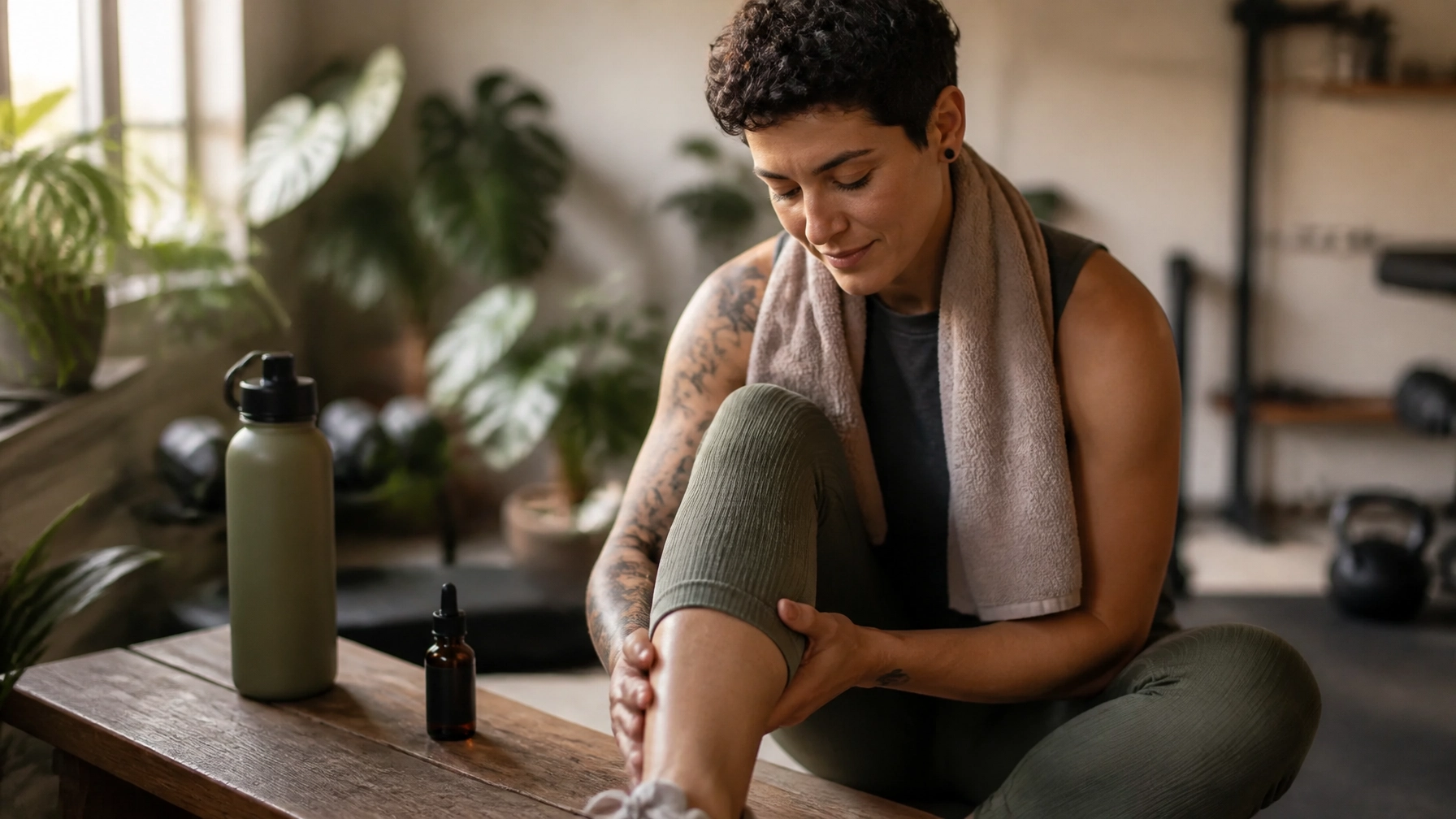
After a challenging workout, recovery becomes the next part of training. Hydration, nutrition, rest, mobility work, and sensible programming all help your body adapt. But could cannabinoids add anything to that process?
Interest in cannabis for exercise recovery is growing among recreational athletes, runners, lifters, and people managing occasional post-workout soreness. The science is promising in a few areas, but it is far from settled. Some studies suggest that CBD may influence pain perception or markers of muscle damage. THC may make soreness feel less noticeable for some people, but it can also impair coordination and reaction time. CBG is intriguing, yet exercise-specific human research is still extremely limited.
Here at Green Grove Bud, we believe informed decisions start with accurate information. So let’s look at what cannabinoids may do, what they have not been proven to do, and how athletes are approaching them responsibly.
The endocannabinoid system and exercise recovery
The endocannabinoid system, or ECS, is a network involved in pain signaling, immune activity, stress response, mood, and homeostasis: the body’s effort to maintain balance. It includes cannabinoid receptors such as CB1 and CB2, naturally produced endocannabinoids such as anandamide, and enzymes that create and break down those compounds.
Exercise itself appears to influence the ECS. Physical activity can increase circulating endocannabinoids, which may contribute to the calm, uplifted feeling sometimes called a “runner’s high.” This does not mean cannabis is required to produce that response. It means exercise and cannabinoids both interact with some of the body’s pain and stress-regulation pathways.
Plant cannabinoids can influence the ECS and related targets:
- THC activates CB1 receptors more directly, producing intoxicating effects and altering pain perception, coordination, attention, and time perception.
- CBD does not produce a traditional high and appears to modulate ECS activity indirectly. It also interacts with targets involved in inflammation, pain, stress, and nervous-system signaling.
- CBG interacts with CB1 and CB2 receptors as well as other pathways, including certain TRP channels and inflammatory signaling networks. However, its role in post-exercise muscle repair remains largely theoretical.

This biological overlap explains why researchers are studying cannabinoids for recovery. It does not prove that using cannabis will rebuild muscle faster or improve athletic performance. Mechanisms are a starting point: not a finished conclusion.

Can cannabinoids reduce inflammation and muscle soreness?
Hard training creates a normal inflammatory response. Small amounts of muscle damage and inflammation help the body adapt to exercise. The goal is not necessarily to eliminate all inflammation. Instead, recovery involves managing excessive discomfort while allowing useful adaptation to occur.
Preclinical studies suggest CBD and CBG may influence inflammatory messengers, oxidative stress, and pain pathways. In cell and animal models, researchers have observed effects involving cytokines such as IL-1β and IL-6, along with pathways associated with immune-cell activation. These findings are biologically interesting, but they do not automatically translate into better recovery for humans.
Human research is more mixed. A small study involving trained participants found that a single 60-milligram dose of CBD after eccentric exercise modestly reduced creatine kinase and myoglobin: blood markers associated with muscle damage: over 72 hours. However, the changes did not consistently translate into better strength, power, or overall recovery.
Other research has found little or no meaningful effect on soreness, inflammatory markers, or performance restoration. One study of topical CBD applied after exercise-induced soreness did not find a significant reduction in soreness or nerve sensitivity compared with placebo. A 2024 systematic review likewise concluded that CBD research in sports recovery remains limited and inconclusive (systematic review).
That distinction matters. Lowering a laboratory marker is not the same as accelerating muscle repair. Feeling less sore is also not necessarily the same as recovering more fully. Cannabinoids may help some people feel more comfortable, but current evidence does not support describing them as proven muscle-building or recovery supplements.
CBD versus THC for recovery
CBD and THC are often discussed together, but they offer very different experiences.
CBD: less impairment, more uncertainty
CBD is the cannabinoid most often discussed in sports recovery research. Potential benefits include:
- Reduced pain sensitivity for some users
- Possible effects on inflammatory and oxidative-stress pathways
- A calmer post-workout experience
- Indirect support for recovery when discomfort or stress interferes with normal routines
The evidence remains preliminary. Some trials show modest changes in muscle-damage markers, while others show no significant improvement in soreness, strength, or performance. CBD can also cause side effects, including digestive upset, fatigue, appetite changes, and interactions with medications. It is not automatically risk-free because it comes from a plant.
THC: stronger subjective relief, greater trade-offs
THC may reduce the perception of pain through CB1 receptor activity. That could make post-workout discomfort feel less intense. Some athletes also report that THC helps them relax after demanding training.
But subjective relief has important limits. THC can impair balance, reaction time, judgment, and coordination: the same skills needed for safe lifting, cycling, climbing, driving, or sports practice. It can also increase heart rate and may affect motivation or next-day alertness. Reviews of cannabis and exercise generally find no reliable performance benefit and sometimes identify potential disadvantages (review of cannabis and athletic performance).
For those reasons, THC is better understood as a possible pain-perception tool than a proven muscle-recovery aid. It should not be used before training or during activities that require concentration and physical precision.
CBG: promising, but largely untested
CBG has drawn attention because early laboratory research suggests anti-inflammatory and pain-modulating effects. A small pilot study of a product containing both CBD and CBG found reduced subjective soreness after a delayed-onset muscle soreness protocol. However, the product contained additional ingredients, and the study could not identify CBG’s individual contribution.
There are not yet robust human trials showing that CBG alone improves muscle repair, strength recovery, endurance, or long-term training adaptations. Claims that CBG is a superior recovery cannabinoid go beyond the available evidence.
Microdosing versus a full dose
“Microdosing” usually means taking a very small amount intended to produce subtle effects with minimal impairment. It is common in wellness conversations, but there is no universal scientific definition or standardized recovery dose.
A smaller amount may be more practical for people who are sensitive to cannabinoids or want to minimize unwanted effects. The trade-off is that a microdose may not produce a noticeable benefit: and may be much lower than the amounts used in research.
A larger or “full” dose may create stronger effects, but stronger does not mean more effective. It can also increase the likelihood of drowsiness, dizziness, anxiety, digestive symptoms, or impairment. The 60-milligram CBD dose used in one exercise study should be viewed as a research condition, not a personal dosing recommendation.
If an adult chooses to experiment where legal and appropriate, the responsible approach is to start low, go slow, avoid stacking multiple products, and give each trial enough time to understand the effect. Track soreness, mobility, perceived readiness, and next-day alertness rather than assuming a product works.
Topicals versus oral products
Delivery method changes the experience.
- Topical products: such as balms or creams: are applied to a specific area. They may be appealing for localized discomfort, but absorption varies and exercise-recovery research is limited. A topical should not be assumed to repair damaged muscle beneath the skin.
- Oral products enter the digestive system and generally take longer to produce effects. Onset can be delayed, and effects may last longer than expected. This makes oral cannabinoids a poor choice immediately before driving, training, or other demanding activities.
- Inhaled cannabis acts quickly but introduces respiratory concerns and can make impairment harder to manage. It is not necessary for exploring the recovery question and may be a less suitable choice for people focused on endurance or lung health.

Choose products with transparent labeling and independent testing when possible. Some CBD products contain more or less CBD than advertised, and products labeled “THC-free” may still contain trace amounts. Contamination is especially important for competitive athletes.
A practical recovery tip athletes are using
One thoughtful approach is to treat cannabinoids as an optional experiment: not the foundation of recovery. An athlete might choose a low-stakes rest evening after a familiar workout, use one clearly labeled product, and record:
- Muscle soreness the next morning
- Range of motion and perceived readiness
- Sleep quality without making sleep the only outcome
- Energy, coordination, and motivation the following day
- Any side effects or medication concerns
This simple journal can reveal whether a product offers meaningful value or merely changes the perception of discomfort. It also helps prevent escalating use based on one unusually good or bad workout.
Most athletes should begin with the fundamentals: adequate protein and calories, fluids, progressive training, active recovery, mobility work, and consistent rest. Cannabinoids should not replace those practices.
Safety, legality, and responsible use
Before using THC, CBD, or CBG, consider your health history and medications. CBD and other cannabinoids may interact with prescription drugs through liver enzymes. Speak with a qualified healthcare professional if you take medication, have a liver condition, are pregnant or breastfeeding, or are managing a significant injury.
Always follow these safety basics:
- Start low and go slow.
- Do not drive, cycle in traffic, swim, climb, or operate equipment while impaired.
- Avoid combining cannabinoids with alcohol or other sedating substances.
- Do not use THC before workouts or competitions.
- Check local laws and sports-governing-body rules.
- If you are drug-tested, remember that THC is prohibited in competition under the World Anti-Doping Agency prohibited list. CBD is permitted by WADA, but contaminated products can still create testing risks.
The bottom line on cannabis for exercise recovery
Cannabinoids may influence pain, inflammation, and stress pathways connected to recovery. CBD has the strongest exercise-specific research base, but results are small and inconsistent. THC may make soreness feel less noticeable while creating meaningful safety and performance concerns. CBG is scientifically interesting but remains largely unproven in human exercise settings.
So, can cannabis improve post-workout recovery? Possibly for subjective comfort in some people, but science has not yet shown that it reliably speeds muscle repair, restores strength, or improves long-term athletic adaptation.
This is an emerging field with important research gaps, including better studies on dose, delivery method, sex differences, training status, long-term use, and the balance between reducing harmful inflammation and preserving healthy adaptation. Until those answers arrive, our most responsible path is to stay curious, use science-backed information, and make careful, informed decisions in a stigma-free environment.